 Entrepreneurs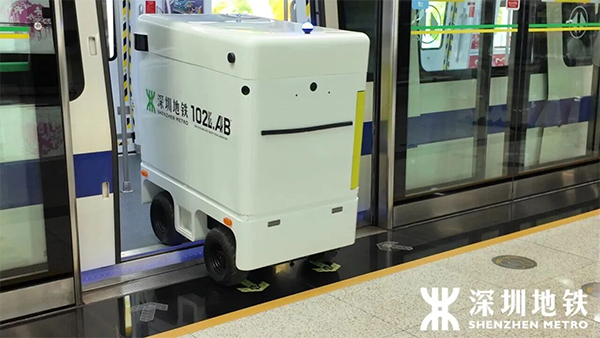
The “1024 Robot” can board and exit metro trains. Photos from Shenzhen Metro unless otherwise stated
Logistics robot serving metro
An AI-driven logistics robot developed by a team led by He Zhijian, an assistant professor at the Shenzhen Technology University (SZTU) School of Artificial Intelligence in Pingshan District, has been deployed at Shenzhen Metro stations. The project also won an innovation award at the China Hi-Tech Fair.
Named the “1024 Robot,” the system connects warehouses, streets, metro lines, and residential communities into a continuous logistics chain. It coordinates tasks including merchant replenishment, central kitchen distribution, and neighborhood commercial deliveries, all supported by an AI dispatch platform.
Built for real-world operations, the robot can enter metro stations, pass through gates, take elevators, and board and exit trains. It navigates complex environments using automatic obstacle avoidance and speed control. The system targets time-sensitive deliveries, such as courier parcels, fresh produce, and medicine, with a reported five-hour citywide delivery capability.
He noted that the system is designed to address three major challenges faced by metro-area merchants: limited restocking time, insufficient storage space, and high labor costs. He added that navigation and decision-making in these highly unstructured environments can be even more demanding than Level 4 (L4) autonomous driving for passenger vehicles.
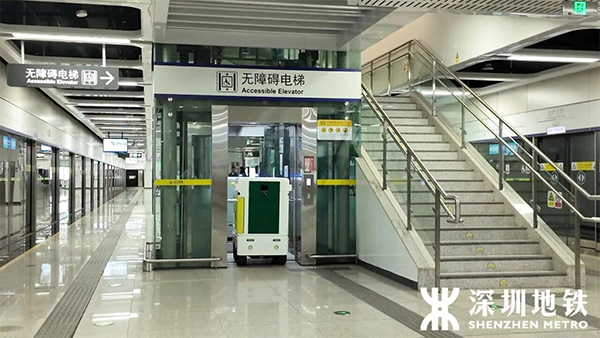
The “1024 Robot” can take elevators.
Founding 1024 Robotics
He holds a Ph.D. from the Hong Kong Polytechnic University. Before joining SZTU in 2023, he served as a senior engineer at Huawei and worked as a research associate at the Hong Kong University of Science and Technology (HKUST). He later founded Shenzhen 1024 Robotics Technology Co., Ltd., where he serves as CEO and CTO.
The company focuses on intelligent robots powered by an AI “brain” core, including commercial cleaning robots (both indoor and outdoor) and rail logistics robots for intra-city deliveries.
As an industry-university-research spin-off, the company has more than 80% of its workforce dedicated to R&D, and it holds multiple patents covering embodied AI algorithms, motion control, and perceptual interaction. Joint labs with SZTU, HKUST, and South China Normal University support its full-stack in-house development across algorithms, hardware, and real-world testing.
Following a strategy of full-chain self-reliance and control, the company has built a full-stack in-house development system spanning AI models and algorithms, drive-by-wire chassis, and chip manufacturing. Its Android-like unmanned platform can be deployed across multiple scenarios, breaking through the technological inertia and cost barriers in the low-speed autonomous vehicle industry.
In a previous interview, co-founding partner Cai Xiaohu said Pingshan District played a key coordinating role during the company’s development — matching the company with high-quality application scenarios and clients, securing a 3,400-square-meter facility for R&D, offices, testing, and production at the Pingshan Urban Construction Investment Smart Park, and granting road-testing permits for its unmanned vehicles.
Leveraging Pingshan’s rich AI scenario ecosystem, 1024 Robotics has expanded from rail-based systems into ground logistics, commercial cleaning, and outdoor sanitation. Its flagship “deployment-free” commercial cleaning robot, the world's first of its kind, has secured orders for thousands of units, with the first mass deliveries scheduled to begin in the third quarter of 2026.
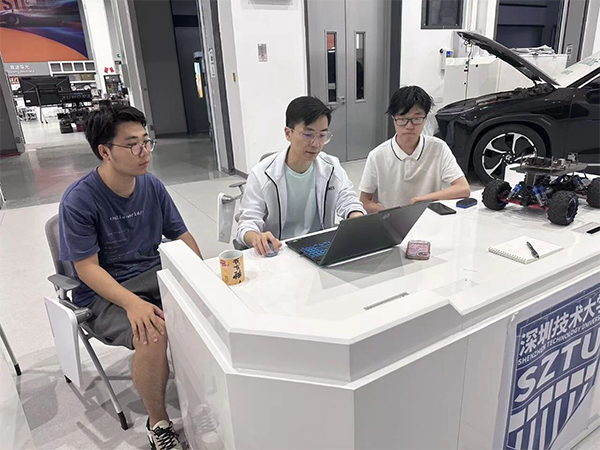
He Zhijian (C) works with his students. Photo from Shenzhen Technology University
Training students for entrepreneurship
He Zhijian believes entrepreneurship based solely on academic papers is unrealistic. He stresses that teams must understand real industry demand and focus on scalable, commercially producible solutions. As an applied research university designed to serve industrial needs, SZTU offered the environment that helped him both teach and start a business.
He trains students with practical, industry-oriented capabilities — from R&D and engineering design to supply chain management — with a goal of building robots that can operate commercially, not only serve as prototypes. He also notes that students may gain strong earning potential after graduation if they can withstand intensive training.
Two of his students, Li Junwei and Zhang Yao, described their transition from classroom learning to product development. They tackled challenges including understanding CAN protocols, chassis control, simultaneous localization and mapping (SLAM), and deploying real-world navigation systems — solving problems through discussion and iteration with He.
Zhang said the experience reshaped how he learns. Instead of focusing only on grades, he learned how to design products that can be manufactured reliably at scale, paying attention to durability, cost control, and mass production. He credited He with teaching him that the ultimate test of technology is whether it can solve real-world problems.

ICP Registration Number: 粤ICP备17054870号-1
 Police Registration Number:44031002000124
Website ID: 4403910001
Police Registration Number:44031002000124
Website ID: 4403910001
Government Service Hotline: 0755-12345
Website Technical Support:zwxx@szpsq.gov.cn
Sponsored by: General Office of CPC Pingshan District Committee (General Office of Pingshan District People's Government, Foreign Affairs Office of Pingshan District, and Archives Administration of Pingshan District)



 HOME
HOME PINGSHAN GOVERNMENT
 NEWS
NEWS ABOUT PINGSHAN
 INVEST IN PINGSHAN
 LIFE
LIFE SERVICES
 FAQ
FAQ CHINESE
 FRANÇAIS
 日本語
日本語 한국어
한국어